Introduction:
There are many ways to throw cards in the tarot, as there are thousands of decks. The objective of this is to find both the deck and the method of circulation that best suits your spirit. To help you find your personality as a tarot player, I’ll bring you a new spin. Anyway, before reading about this print run, I recommend you read about the print yes or no and the cross print. Both articles can be found on the blog.
The Star Roll:
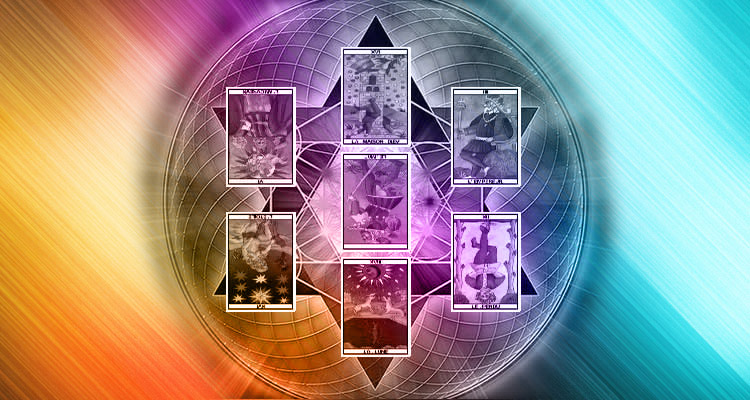
This is a circulation that allows us to have a greater understanding about the question or event presented by the client. As the name implies, the key is to place the cards forming a star. Some tarot players prefer the formation of the five-pointed star, while others prefer the formation of the Star of David (which has 6 points). In any case, in both cases, 6 cards are used, but in a different arrangement.
It is a good test to assess the current situation in depth, analyzing both the obstacles and the means to solve this issue. In any case, it is important to clarify that no tarot reader knows the future. If we analyze what we call “future” this is about what the consultant FEELS and THINKS about what is going to happen to him / her. But this does not mean that what comes close is exactly that. We have to help our client to believe in himself and to understand that every event (good or bad) is perfect and that he is there to teach it. Higher beings place us in positions that know that within us we have the virtue, attitude or feeling that will help us overcome it.
How is the layout of this roll?

Card 1:
Letter 1 is related to the current situation. This can be both positive and negative. In turn remember that the number “1” is related to the initial strength and think that any “weakness” that the person may feel that has, it must be transmuted to its “virtue”. Being the first card, it is our point of reference and is a key to the answer to the question.
Card 2:
This card is related to the obstacles that the client feels or believes will be faced in the process of resolving the question / conflict to be addressed. A positive card may appear, and this would represent the “tools” available to the consultant to resolve the issue in question. If a negative card appears, we have to help the person to see his virtue in order to solve the problem.
Card 3:
This card has to do with the conditioning of the past. What is it that conditions my client of the past? How is this conditioning linked to the current situation? Clearly it is something that must be learned and therefore, life has put it in a similar situation.
Card 4:
This card has to do with the client’s strengths. In any case, if a negative card comes out, it is precisely because the client is not seeing his strengths, which would help him solve the problem. If an inverted (negative) card comes out we have to think What are the virtues of this card in its positive state? Since these are the key for the person to find the solution.
Card 5:
The challenges that may prevent us from finding a solution. It has to do with those situations that can (again) impede the meeting of a response to the problem in question. It can be something that the consultant feels will happen to him. It is important to ask: In the process of resolving this conflict, what do you feel can happen? Why do you feel that this reaction will make you return to the starting point?
Card 6:
The final solution related to how the consultant has to work to solve this issue. We have to ask ourselves, through which process can this question be resolved? Remember that this process has to be for the benefit of all involved. What is the best way to solve this problem / issue without negatively affecting the beings involved?


