
Introduction:
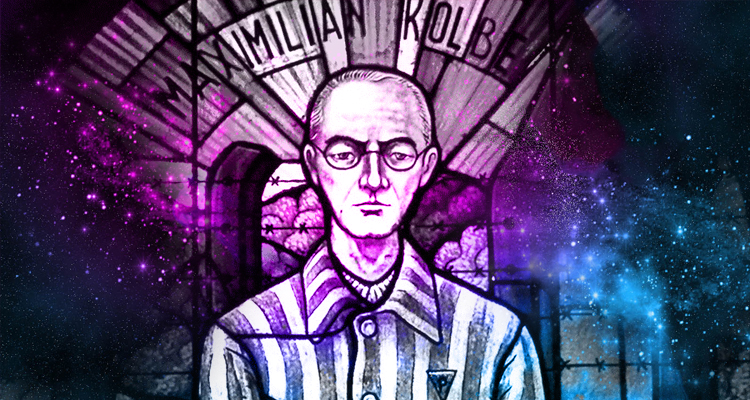
In this week of August 14, I will tell you about St. Maximilian Kolbe. The name Maximiliano means “the most important of the family” and so it was since he gave his life in exchange for the release of a family man in a concentration camp. In response to this event St. John Paul II described St. Maximilian in the following words: “Maximilian Kolbe did as Jesus did, he did not suffer death, but donate life.” In this month of August, full of personal changes, we must remember that the people around us are important too and that they also help us to give meaning to our lives.
History of St. Maximilian Kolbe:
Born on January 8, 1894, in the Polish city of Zundska Wola, from a young age he was devoted to the virgin. Due to a mischief of his childhood, Maximilian prayed to the virgin for forgiveness and answers. His change of attitude did not go unnoticed by his mother who asked the cause for which he prayed on a small altar they had in their home. Maximilian replied that he had a meeting with the virgin and described it in the following words: “Mom, when you reproached me, I asked the Virgin very much to tell me what would become of me. The same thing in the church, I prayed again. Then the Virgin appeared to me, holding two crowns in her hands, one white and one red. The white meant that I would persevere in purity and the red one that I would be a martyr. I replied that I accepted them … (both). Then the Virgin looked at me sweetly and disappeared. “This is how Maximilian inherited from his parents the love for the Mother of God.
In 1910, Maximilian was accepted as Franciscan. Five years later obtained from the University of Rome the doctorate in philosophy, in 1918 was named priest and in 1919 obtained the doctorate in theology. This saint dedicated his life so that people can venerate the Virgin. He successfully founded, in both Poland and Japan, the organization known as the City of the Immaculate. He also founded two newspapers known as “The Knight of the Immaculate” and “The Little Diary”.
On September 1, 1939, the Nazis invaded Poland. This historical fact was recognized as the trigger of World War II. Faced with this event, the City of the Immaculate was bombed and Maximilian was taken prisoner. One day, a prisoner ran away. This caused the military to take the measure of killing 10 prisoners. The election of the same was carried out through a lottery. When the number 10 was chosen, he was a man who claimed he had family and children. It was thus that Father Kolbe spoke among the crowd and said, “I offer myself to replace the companion who has been appointed to starve to death.” The officer asks the Father why he made such a decision and he replied: “He has a wife and children who need him. Instead, I’m single, alone and nobody needs me. “In response, the officer accepts his decision. He passed away the 14 of August of 1941.
The Holy Father Paul VI, in the face of events, declared him blessed. In his commemoration, the man whom he had saved was present. John Paul II, declared him Holy, in front of the Polish crowd. This is how St. Maximilian Kolbe is remembered and commemorated. He sacrificed himself for a brother who needed help.
Conclusion:
In the month of change, we have to think not only of our own changes but also of the changes we make to others. It is never too late to help another. Regardless of your religion or beliefs, we are all human beings, we come from the same place and we go to the same place. Although the journey of each of us is different, Saint Maximilian teaches us the importance of helping others when they need it most. It is for this reason that not only helps yourself to grow and elevate, but also, take advantage of this energy change to help others so that they can rise.
I leave you with the Buddhist text of the practice of giving so that you can learn about this miraculous action:
“The generosity associated with wisdom before, during and after the act is the highest kind of giving. Three examples of wise giving are: giving the clear understanding that according to the law of kamma of cause and effect, the generous act will bring beneficial results in the future; Give being aware that the gift, the recipient and the one who gives it are all impermanent; And give with the aim of reinforcing effort to enlighten us (to become enlightened). Since giving a gift takes a certain amount of time, a unique act of giving can be accompanied by each of these three types of understanding at a different stage of the process. The most exalted motive to give is the intention that strengthens our effort to attain Nibbana.” Quotation from the Book The Practice of Giving, written by Susan Elbaum Jootla.
Phrase: Always live as if it were the last day of your life, because tomorrow is insecure, yesterday does not belong to you and only today is yours.


